DECK 03
PERCEPTION & EXPANSION
What reaches outward
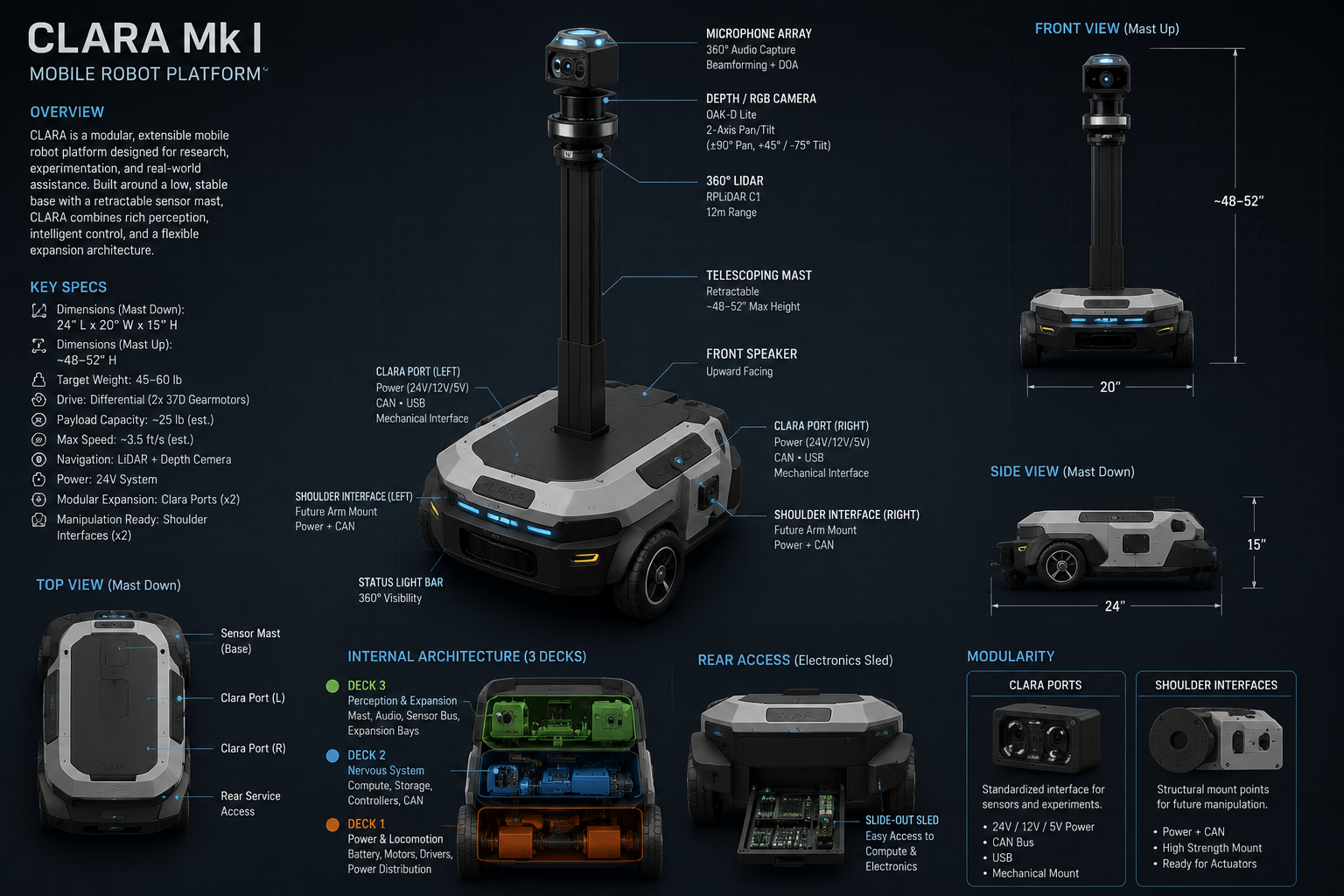
Mast and perception systems, audio, sensor integration, and expansion live closest to the platform's changing edge.
Cognitive Locomotion & Autonomous Robotic Architecture
A modular mobile robotics architecture being designed to perceive the world, understand its own state, and gain new physical capabilities without rebuilding the platform around them.
The current work is not a polished robot reveal. It is the less glamorous—and more important—part: deciding what the machine needs to know, where systems belong, how they connect, and how the architecture survives iteration.
Modern AI can work across enormous amounts of information while remaining physically detached from the consequences of its output. Give intelligence a body and the problem changes immediately.
Movement creates state. Perception needs spatial context. A sensor can disagree with another sensor. A wheel can slip. A module can disappear. A physical system has to notice what is happening while it is happening.
CLARA is our attempt to design that connection deliberately: a stable mobile core, an elevated perception architecture, organized internal systems, and standardized places for future capability to attach.
Inspect the current architecture. Mk I establishes the mobile core and perception mast. The future study shows manipulation added through interfaces already considered in the base—not a separate robot designed from scratch.
Hover, focus, or tap a region on the schematic — or select a category — to inspect part of the architecture.
The current mapping uses functional decks as an organizing constraint. This is not a published component map; it is a way to keep power, coordination, perception, expansion, and service access from becoming one undifferentiated box.
Mast and perception systems, audio, sensor integration, and expansion live closest to the platform's changing edge.
Processing, storage, communication, and system coordination form the middle layer between observation and physical action.
Energy, distribution, drive control, and locomotion remain low in the chassis where mass and service boundaries matter.
The shell is not the project. Structure, access, sensing, movement, and system boundaries get resolved first.
CLARA Ports and reserved manipulation interfaces exist because the useful hardware six months from now may not be the hardware selected today.
Experimental machines get opened. Frequently. Compute, control, power, and expansion systems are being organized around inspection and replacement.
The platform should build state from multiple forms of feedback instead of trusting a single isolated measurement.
Movement, interfaces, and system behavior should be challenged virtually before expensive parts become the test fixture.
CLARA is in physical mapping because these choices compound. A convenient decision at the sensor mast can become a service problem in the chassis or a limitation at a future interface.
What belongs in the core platform, and what should remain an expansion module?
How much physical state should CLARA understand locally?
Where does redundant sensing become useful rather than wasteful?
What should remain functional when a subsystem becomes unavailable?
How do you make a robot easy to change without making it structurally vague?
How much can be invalidated in simulation before fabrication begins?
The immediate goal is to turn the architecture into a defensible physical layout before fabrication: structural regions, internal layers, sensor relationships, expansion boundaries, and access paths.